Delve into the world of square foot with this comprehensive guide that uncovers the mysteries behind this common yet crucial unit of measurement. From real estate to construction, square foot plays a pivotal role that impacts various industries in unique ways.
Get ready to explore the fascinating realm of square foot and discover its significance like never before.
Square foot is more than just a number – it’s a key player in shaping our built environment. Let’s dive in and unravel its complexities together.
Definition of Square Foot
Square foot is a unit of area measurement equal to a square that is one foot long on each side. It is commonly used in real estate and construction to determine the size of a property or building.
Examples of Square Foot Usage
- In real estate, square foot measurements are used to calculate the size of a property and determine its value.
- In construction, square foot measurements help estimate the amount of materials needed for a project and determine labor costs.
- Retail businesses use square foot measurements to determine the size of their store space and plan layouts.
Importance of Understanding Square Foot Measurements
Understanding square foot measurements is crucial in various industries for accurate planning, budgeting, and decision-making. It allows professionals to assess spatial requirements, estimate costs, and optimize space utilization efficiently.
Calculating Square Footage
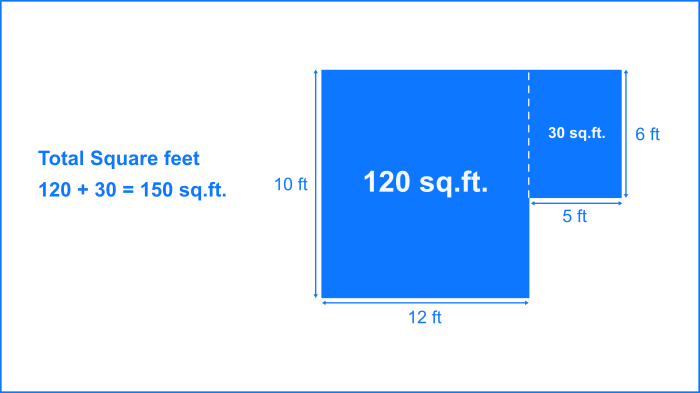
To accurately determine the square footage of a space, whether it is a room, a house, or a piece of land, precise calculations are essential. Square footage is a key measurement used in architecture, interior design, real estate, and construction to estimate costs, plan layouts, and ensure proper utilization of space.
Calculating Square Footage for a Rectangular Space
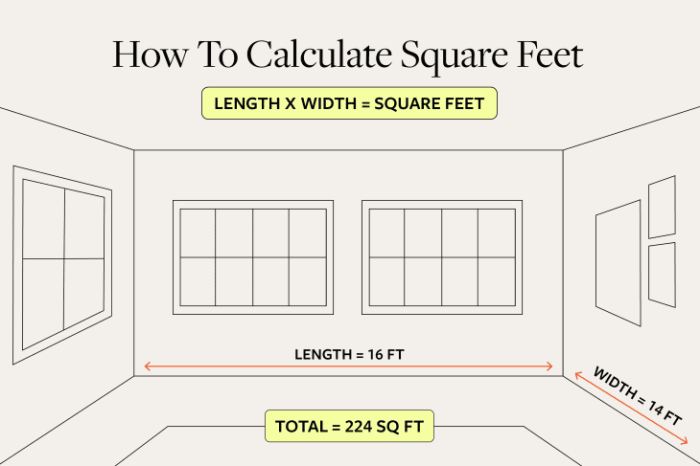
Calculating the square footage of a rectangular space is relatively straightforward. You simply multiply the length of the room by its width. The formula for calculating the square footage of a rectangle is:
Area = Length x Width
Calculating Square Footage of Irregular Shapes
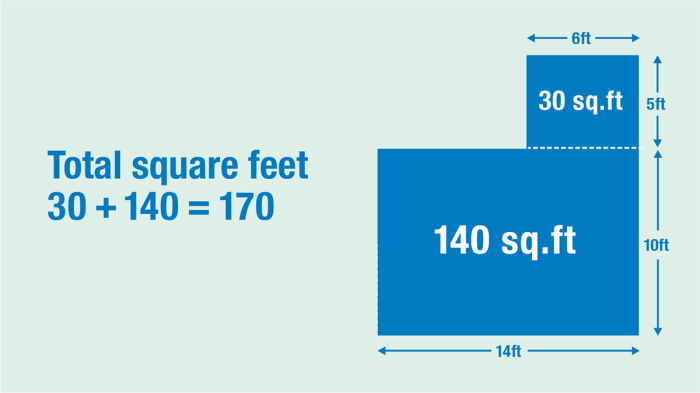
When dealing with irregular shapes, the process becomes slightly more complex. One method is to divide the shape into smaller, more manageable sections (such as rectangles or triangles), calculate the square footage of each section, and then sum them up to get the total square footage.
Alternatively, advanced tools like computer software or apps can be used to calculate the area of irregular shapes accurately.
Significance of Accurate Square Footage Calculations in Architecture and Design
Accurate square footage calculations are crucial in architecture and design for several reasons. They enable architects and designers to create functional and aesthetically pleasing spaces that maximize efficiency and usability. Additionally, precise square footage measurements are essential for estimating material quantities, costs, and complying with building codes and regulations.
Applications of Square Foot in Real Estate
Square footage plays a crucial role in the real estate market, influencing property values, rental prices, and even shaping current trends in the industry.
Impact on Property Value
In real estate, the square footage of a property is a key factor in determining its market value. Generally, larger properties with more square footage tend to have higher price tags compared to smaller ones. This is because more square footage often translates to more living space, amenities, and overall desirability.
- Properties with larger square footage are perceived as offering more value to potential buyers or investors.
- The price per square foot is a common metric used in real estate to compare the value of different properties.
- Renovations or additions that increase square footage can significantly boost a property’s resale value.
Role in Determining Rental Prices
When it comes to rental properties, square footage directly impacts the monthly rental price. Landlords typically charge a higher rent for properties with more square footage, reflecting the increased living space and amenities provided to tenants.
- Rental prices are often calculated based on the price per square foot of a property.
- Properties with larger square footage may command higher rental rates, especially in competitive rental markets.
- Tenants often consider the cost per square foot when comparing rental properties to ensure they are getting the best value for their money.
Trends in Real Estate Preferences
In recent years, there has been a shift in real estate preferences when it comes to square footage. While larger homes were once highly sought after, there is now a growing trend towards smaller, more efficiently designed living spaces.
- The rise of minimalist living has led to increased interest in smaller homes with thoughtful layouts and space-saving features.
- Urban areas are seeing a surge in demand for compact living spaces with modern amenities, catering to a younger demographic seeking convenience and affordability.
- Developers are focusing on creating smaller yet functional homes that maximize every square foot, appealing to buyers looking for practicality and sustainability.
Comparison: Square Foot vs. Square Meter
In the world of area measurements, square foot and square meter are two commonly used units. Let’s explore the key differences between these two units and how they are used in various countries.
Differentiation between Square Foot and Square Meter
When it comes to measuring area, square foot is commonly used in the United States, while square meter is the preferred unit in most other countries. The main difference lies in their size1 square foot is equal to 0.0929 square meters.
This means that for the same area, the measurement in square meters will be larger compared to square feet.
Conversion between Square Foot and Square Meter
To convert square feet to square meters, you can use the following formula:
1 square foot = 0.0929 square meters
Similarly, to convert square meters to square feet, you can use:
1 square meter = 10.764 square feet
Examples of Countries Using Square Foot or Square Meter
United States
Square foot is predominantly used for real estate and property measurements.
Canada
While officially using the metric system, square foot is still commonly used for measuring real estate.
European countries
Square meter is the standard unit used for area measurements in most European countries.
Australia
Square meter is widely used for real estate and land measurements in Australia.
Wrap-Up
As we conclude our exploration of square foot, one thing becomes clear: this seemingly simple unit of measurement holds immense power in influencing how we perceive space and value. Embrace the knowledge you’ve gained about square foot and let it guide you in your future endeavors within the realms of real estate, design, and beyond.
Essential FAQs
How is square foot different from square meter?
Square foot and square meter are both units of area measurement, but square foot is commonly used in countries like the United States, while square meter is more prevalent in countries following the metric system.
Why is it important to understand square foot when buying a property?
Knowing the square foot measurement of a property helps you determine its value, compare it with other properties, and understand how much space you’re getting for your investment.
Can square foot measurements influence rental prices?
Absolutely, the square foot measurement of a rental property is a key factor in determining its rental price. Larger square footage often commands higher rent.